

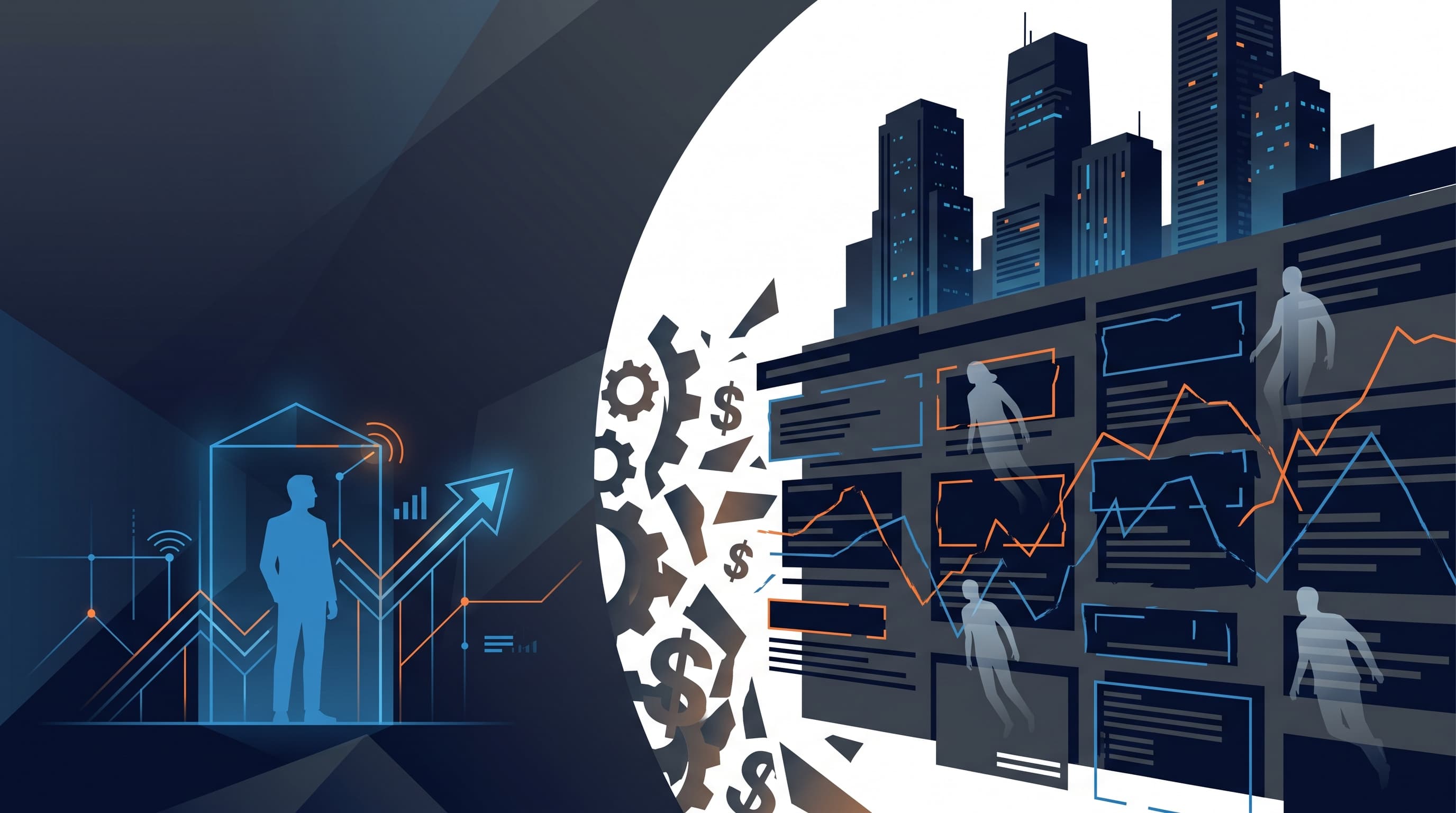
The pain people feel in the labor market is not just the story of AI taking jobs. It is what happens when overhiring, rate shock, SaaS bloat, new grad pressure, and executive convenience all arrive at the same time.
You are not crazy. The labor market feels weird because it is weird.
The False Villain
AI did not walk into a healthy market and knock it over.
The cleanest version of the story is also the laziest one: AI showed up, companies saw a cheaper worker, and the white-collar job market broke. That story has emotional force because people can feel something has changed. It is just too neat. The job market was already bent out of shape before AI became the universal explanation for every hiring freeze, layoff memo, and vanishing entry-level ladder.
AI went mainstream before it was consistently good. The first wave looked like a magic trick with bad judgment. It wrote confident nonsense, invented citations, hallucinated code, and produced the kind of prose that made smart people feel justified in rolling their eyes. Lawyers, engineers, marketers, analysts, and managers all found the failure mode that let them dismiss it. The technology was impressive, sure, but not serious. Not for their work. Not for real judgment.
That skepticism was understandable. It was also dangerous, because it trained professionals to look at the output quality of one moment and miss the direction of travel. Early AI did not need to be better than a great professional. It only needed to get good enough that executives could ask a different question: how many people are we paying because the process requires people, and how many are we paying because the output actually requires them?
The Number Problem
The official labor market and the lived labor market stopped agreeing.
A strange thing happened in the last few years: the headline labor market often looked fine while the experience of looking for work felt deranged. Nonfarm payrolls could print positive. Unemployment could look contained. Commentators could point at aggregates and say the economy was still creating jobs. Meanwhile, a candidate could apply to hundreds of roles, see reposted listings, get silence from companies that were supposedly hiring, and wonder whether the whole market had become a stage set.
This disconnect matters because averages hide the specific places where a labor market can become cruel. A market can add healthcare and hospitality jobs while freezing corporate roles. It can keep headcount stable by replacing one expensive employee with three part-time or offshore workflows. It can show open roles while hiring managers pause budgets behind the scenes. It can produce enough motion to satisfy a chart and still feel dead to the person trying to start, restart, or change a career.
The candidate experiences the market as a queue, not as an economic release. They do not live inside a payroll survey. They live inside application portals, recruiter inboxes, delayed approvals, automated rejections, and job descriptions that ask for five years of experience in tools that barely existed five years ago. That is why the argument starts with shared reality. If the market feels haunted, it is because a lot of the visible demand is not behaving like demand.

The Boom Hangover
2021 taught companies to hire as if gravity had been repealed.
The pandemic did not just change where people worked. It changed what companies thought growth was supposed to feel like. In 2020 and 2021, digital adoption compressed years of behavior into months. Software companies pulled demand forward. Venture money was cheap. Rates were low. Public markets rewarded growth stories. If your competitor was hiring, you hired. If your team was struggling, you opened headcount. If your roadmap looked ambitious, you built the org chart as if the future had already agreed to fund it.
The result was a hiring boom that made sense only inside the money environment that created it. Companies stacked recruiting teams, sales teams, growth teams, enablement teams, RevOps teams, program managers, lifecycle marketers, strategy pods, product squads, platform groups, and layers of coordination to manage the layers of coordination. Some of that hiring was useful. Some of it was insurance. Some of it was status. A lot of it was a bet that growth would keep arriving fast enough to justify the structure built around it.
Then money got expensive. The interest-rate reality changed. Investors stopped rewarding headcount as a proxy for ambition. Efficiency became fashionable again. Suddenly the same organization that was a sign of maturity in 2021 looked bloated in 2023 and irresponsible in 2024. AI did not create that reversal. AI arrived at the exact moment companies were already looking for permission to admit they had built too much payroll around too much process.
The Permission Structure
AI became the cleanest excuse for a messy reset.
This is where the conversation gets uncomfortable. Companies do not always use AI because it perfectly replaces a worker. Sometimes they use AI because it gives leadership language for a decision they wanted to make anyway. The executive does not have to say, "We overhired, our SaaS stack got stupid, our teams are slow, our middle layers are political, and we have no idea which activities create value." They can say, "AI is changing the way we work."
That phrase is useful because it sounds strategic instead of embarrassed. It converts a cleanup into a transformation. It lets a company cut headcount, cancel backfills, slow promotions, freeze early-career roles, and push surviving teams to absorb work under the banner of modernization. Some of that modernization is real. Some of it is theater with better software. The important part is that AI gave companies a socially acceptable way to stop pretending every process deserved a person attached to it.
This is why professionals can feel gaslit. They see managers talk about AI productivity while the actual workflows remain chaotic. They see leaders claim the future is agentic while their company still cannot write a decent job description. They see layoffs justified by technology that is, in many places, still uneven. But the unevenness is not a defense. The first thing AI exposed was not that every role could be automated. It exposed how many roles had been protected by the difficulty of measuring whether the work mattered.
The Market Contradiction
The winners can lift the market without hiring broadly.
The stock market can look strong while the job market feels punishing because the winners are not the whole economy. A small number of enormous technology companies can drive index performance, AI spending, cloud demand, and investor confidence without creating a broad hiring boom. The Magnificent Seven can make markets look alive while thousands of candidates experience something closer to a locked door.
That contradiction is not a footnote. It is central to the feeling of the moment. The companies most rewarded by AI and platform power are often the same companies most capable of growing revenue without growing headcount at the old rate. They can spend billions on infrastructure, buy back stock, consolidate talent, and hire selectively in frontier areas while reducing the need for the armies of coordinators, analysts, and adjacent specialists that used to gather around platform growth.
So yes, AI matters. But the better first sentence is not "AI broke the job market." The better sentence is: AI gave companies the tool, excuse, and pressure to reveal what the job market had already become. Overbuilt in some places. Underpaid in others. Statistical at the top, chaotic at the application layer. Full of openings that do not behave like openings. The question is no longer whether AI is useful. The question is what happens when companies realize they can stop paying for theater.
JobsJudo Ice Breaker
Fresh roles, cleaner shots.
Bring better signal into the search before another good-fit opening turns stale.
Next Part